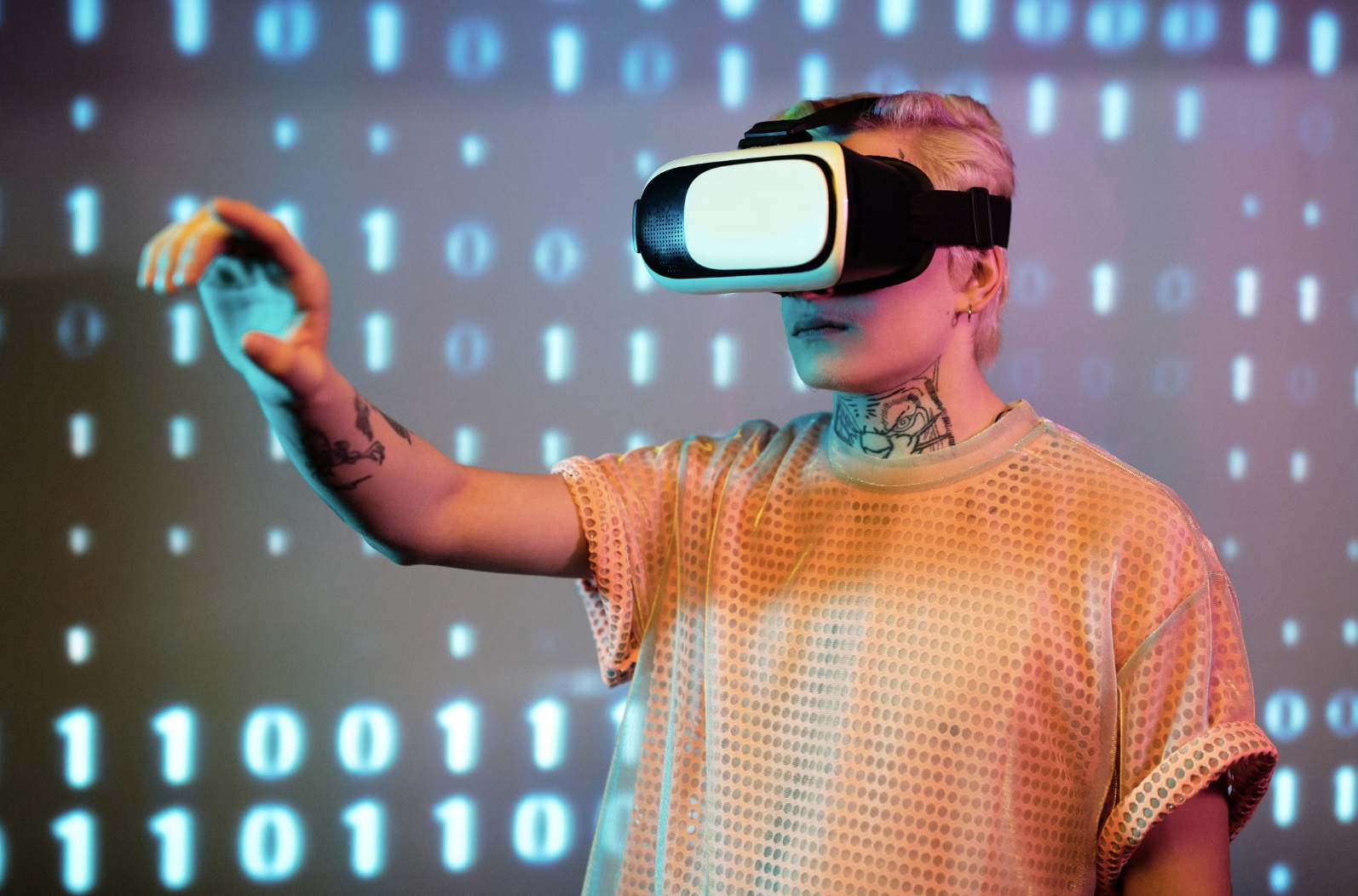
In an era driven by hyper-fast computing and ambient intelligence, technology is moving past the flat glass of smartphones and monitors to redefine how humans perceive reality itself. At the center of this transformation stands Virtual Reality (VR)—a medium that dissolves the boundary between human intent and machine-generated worlds.
What Is Virtual Reality?
Virtual Reality refers to a computer-generated simulation that immerses the user in an interactive, three-dimensional environment. By utilizing head-mounted displays (HMDs), stereoscopic vision, and spatial audio tracking, VR bypasses passive observation. The user does not simply watch a digital world; they step inside it.
Key Sectors Driving the VR Evolution
Next-Generation Gaming and Simulation:
Gaming provided the proving ground for VR hardware and graphics engines. Real-time rendering and low-latency positional tracking now allow players to interact with virtual physics directly, creating unprecedented levels of agency and emotional investment.
Immersive Training and Education:
High-stakes professions increasingly rely on VR for risk-free simulation. Flight pilots train for extreme weather conditions, and medical students rehearse intricate surgical maneuvers inside high-fidelity anatomical models before entering an operating room.
Healthcare and Digital Therapeutics:
Beyond training, VR has proven valuable in active treatment. Clinical setups use controlled virtual environments for exposure therapy, post-traumatic stress management, and non-pharmacological pain distraction during procedures.
Spatial Collaboration and Remote Work:
As distributed teams become the standard, flat video calls often lack the organic dynamic of physical collaboration. VR workrooms bring colleagues together as interactive avatars around shared 3D models and whiteboards, reducing visual fatigue and bridging geographic gaps.
The Bridge to the Metaverse
VR is the primary sensory gateway to the Metaverse—a persistent, interconnected virtual space powered by spatial computing, cloud infrastructure, and decentralized digital economies. In this persistent digital layer, users can collaborate, own verified assets, and build social ecosystems that exist continuously alongside the physical world.
Looking Ahead
Form factor constraints, battery efficiency, and motion ergonomics remain challenges being actively solved by hardware engineers. With the maturation of high-speed 5G/6G connectivity, edge cloud rendering, and compact pancake optics, VR is shedding its bulk and moving toward widespread, everyday integration across industry and consumer life.
tech
Virtual Reality (VR) and the Metaverse: Stepping into the Next Digital Era
Explore how Virtual Reality (VR) is breaking beyond gaming to redefine education, remote work, healthcare, and the emerging architecture of the Metaverse.