Let us consider you have a passion for fruits. It becomes tiring for you when each day you go to the local market, select the fruits individually, bargain on the prices, and pray they do not become bad fruits.
Now what if the fruit vendor offers you a "Ready-made Fruit Basket," which includes the best 50 or 500 fruits available in the whole market?
This is the very basic concept of Passive Investing. There is no need for you to worry about the stocks individually (as in choosing either Apple or Tesla stock, whichever will perform better next day). You only have to buy a basket that includes everything from the market or a particular industry.
Index Funds and ETFs: What Are They?
In essence, both share one common purpose – tracking a particular index of the market. A good illustration is the S&P 500 index that consists of the 500 biggest publicly traded corporations within the U.S.
By purchasing an index fund or ETF of the S&P 500, your money will automatically go into Microsoft, Apple, Amazon, Nvidia, and many others. As long as the country’s economy is growing, your capital will grow alongside it.
Despite the fact that the contents of the basket are almost equal, there are major differences in trading and managing them.
Example From the Real World: Meal-kit Subscription Service Vs. Food-court Order Counter
Please go through the following example for better understanding:
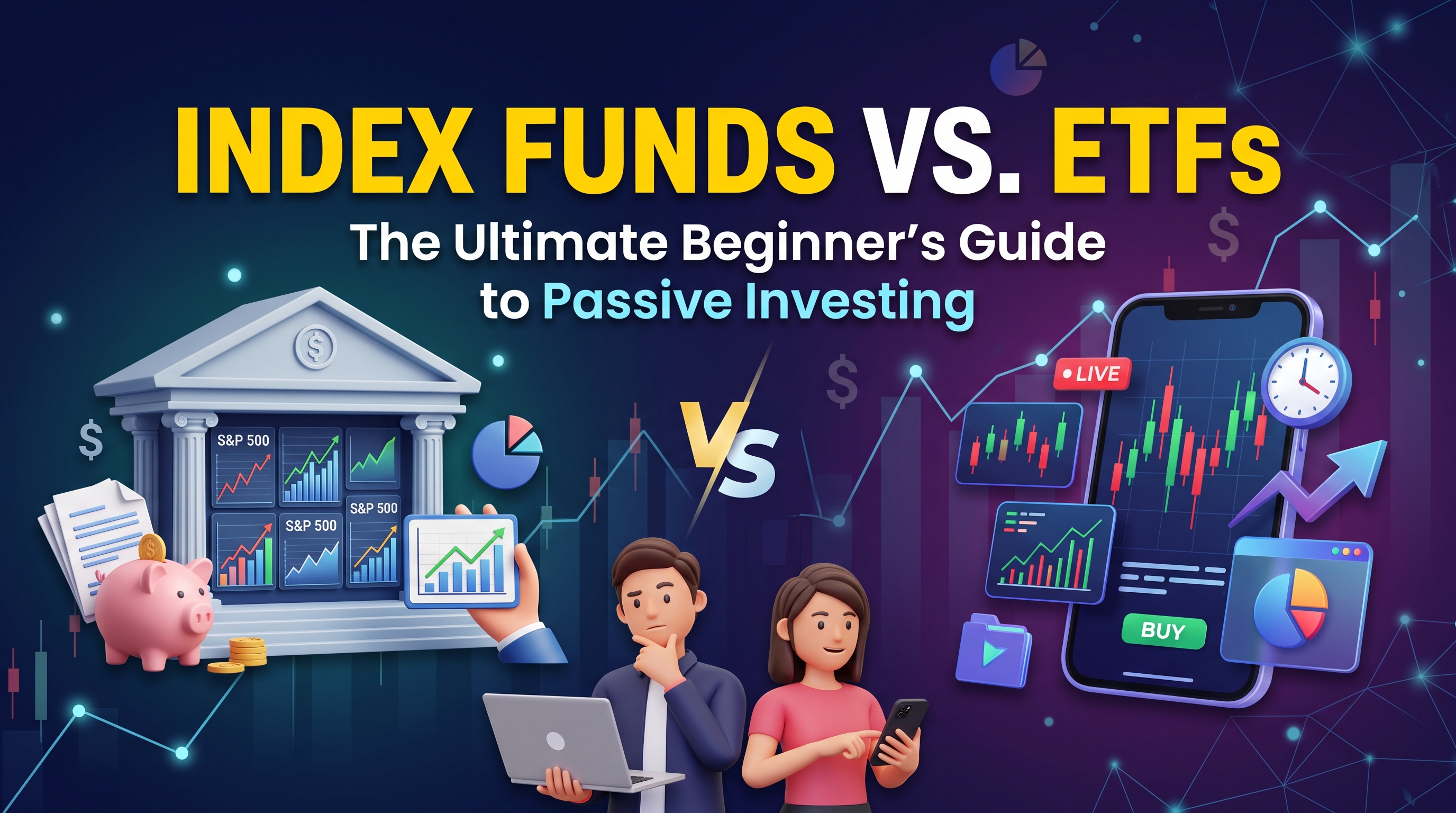
- Index fund (Meal-kit subscription): In such a case, you pay for a subscription package which includes food items and gets automatically deducted from your bank account based on the average price per share of the day which is referred to as the NAV. In this case, you don’t need to keep an eye on charts, graphs, and prices because nothing happens during 11:30 AM.
- Exchange traded fund (ETF) (Food court counter): In this case, your ETF functions as any other stock and changes price every second. You will be logged into your brokerage account and monitor the ETF prices and place market/limit orders depending upon the situation.
Comparison Depending on Time and Place of Transaction
- Index Fund: 1 transaction per day (closing / Net Asset Value)
- ETF: At any time in trading day
Automatic Investments (Dollar Cost Averaging/SIPs):
- Index Fund: It will be simpler as direct deposits will be done automatically
- ETF: Manual investments (unless automatic transactions are not offered by the broker)
Minimal Investment Needed:
- Index Fund: The minimal investment may vary from $1
- ETF: Minimal investment would be the same as 1 share (fractional shares are accepted)
Order Types:
- Index Fund: Only dollar orders are possible
- ETF: Market, Limit and Stop-Loss Orders are available
Expense Ratio:
- Index Fund: Very low (0.04%-0.10%)
- ETF: Very low (0.02%-0.08%)
Which One Should You Opt for?
Both of these types of investments are world-class ones. It all depends on what kind of personality traits you have:
Opt for Index Funds if:
- You like taking a “Set it and forget it” route. You would like to have some money automatically withdrawn just after your paycheck comes in every month without any need to log in and analyze the charts.
- Fluctuations in the market bother you.
Opt for ETFs if:
- You are already using a brokerage platform and like trading assets.
- You are looking for immediate liquidity and quick order execution.
- You are aiming for the lowest expense ratio possible.
Most Common Mistakes Made By Beginners?
The charm of using the passive investing method is its simplicity. The most common mistake that beginners make while following this approach is trying to play the market either through timing or by panicking when the market falls.
Passive investing is not some magic wand which will help you make quick money; it is more like the science of earning compounded interest. Be it an index fund or an ETF, the trick is consistency.